Author Archives: davidsmith4002

Better Prayer Through Calculus

When I was learning calculus, back in the dark ages, I remember having great difficulty grasping the very basic concept of “the slope of a point.” It sounded completely illogical, then and now. After all, didn’t Euclid define a point as having location, but not dimension (no length, width, or size). Without at least length, how can it have slope, which describes a direction (up, down, left, right, angled…)?

Well, calculus and its sloping points turn out to have lots of valuable uses. (I’d list them now if I could remember any.)

But I do recall the procedure for demonstrating and determining the slope of a point. It involves gradually vanishing “limits”.  A limit (if I remember correctly, or even approximately) is the slope or angle of the smallest possible section of a graphed curve in the area of the point in question. You start with one inch on either side of the point, and measure the slope of that two-inch line between them. Then you repeat the process with half that distance, then keep halving it. Eventually, the series of those slope-measurements closes in on the slope of the particular point. Voila! Cool, no?

(Well, anyway, that’s how I remember it.  If I have gotten it wrong, I hope some helpful mathematician or engineer or calculist will write a comment straightening me out.  I’d hate to misinform my faithful readers.)

I said above that this all has many valuable uses, which I knew once long ago. But I have recently found a new one, for my prayer life.

Prayer takes place in time. We sing of the “Sweet Hour of Prayer.” We recite prescribed prayers (Ave, Our Father, Memorare, the Rosary, etc.); these prayers are of definite length in words spoken and therefore in time.  Monks and nuns pray at specific times throughout the day.

But this implies that the rest of our time is spent in non-prayer. Many of us seek to increase our time spent in prayer. Extending prayer time of course reduces our non-prayer time. But is there another way to increase prayer by converting non-prayer time into prayer time (NPT into PT, as it were)? Continue reading

Moleman, Chesler, Zweig on Dying Cities

I see that my friend Mister Hans Moleman has written an interesting reference to Buchmendel, a great short story by Stefan Zweig.  He being one of the greatest writers of all time (Zweig, not Moleman), I was intrigued by his (Moleman’s, not Zweig”s)  linkage with some reflections on the decay of cities (specifically “Old Manhattan”) by Dr. Phyllis Chesler.

My favorite of Zweig’s writing is his novel Beware of Pity.  “Buchmendel” is a great story.  Phyllis Chesler is a brilliant commentator.

And Moleman is pretty good, too. If you like his kind of stuff.

Three Random Questions

[NOTE: If I were a better writer, I would have developed each of these thoughts into a full-length essay.  But this is the best I can do right now.]

How does an atheist explain Euclid? In a purely material world, what is a perfect circle or a straight line or a point? These do not exist in nature. If they are mere ideas, mental constructs, thoughts made up of flashing neurons, then why do they work so well to explain reality?  Why does geometry work? Why can a mere thought become a building or a bridge?

Would it be fair to describe Richard Dawkins and his progeny as “Hard Shell Atheists”?

I am of course thinking of the term “Hard Shell Baptists”, coined to describe (indeed, self-describe) the “Primitive” or “Old School” who self-separated from the more mainstream Southern Baptists.   Starting in 19th century rural America, they rejected any religious activity beyond the church walls and home prayer; even missionary societies and Sunday schools were unacceptable to them. “If it isn’t explicitly ordered in scripture, it is untrue and unchristian.”

Some of today’s atheists sound vaguely similar, at least in tone.  “If it isn’t written in science, it is untrue.” “If it hasn’t been answered by science, it soon will.” “If it can’t be answered by science, it can’t be asked.”  Dawkins’ thinking often seems to be carefully isolated within a hard protective shell.   Some writers have called this “scientism”, a faith in science as the one and only path to understanding: “sola scientia”, instead of “sola scriptura”.

Am I being unfair? Maybe. I will try to pray for the enlightenment of all atheists.

When does purgatory begin? Not until we die (assuming we die in a state of grace)?As I understand it, purgatory is the state of suffering in expiation for the sins we have repented.  If so, then purgatory begins with repentance, and does not end with priestly absolution. “Ego te absolvo” is not the finish line.  The memory of our sins is the lifelong experience of the repentant sinner whenever he contemplates his own past. Every memory can conjure up the pain and shame of his sinfulness at its worst. At least it is so for me.

Perhaps this unwillingness or inability to cast off the memory of my sins is in itself a sin, an unwillingness to accept God’s merciful love.  If so, I am just digging my hole deeper.

But if this pain of remembered sin is in fact the act of purgation, if this is the unstated part of penance, then perhaps I should not resist.

Dante’s Purgatorio (purgatory) is by far the most interesting part of his Divine Comedy.  For me the Inferno (hell) is too darkly comical, and Paradiso (heaven) is frankly too sweet.  But in Purgatory, our humanness is realistically but hopefully portrayed.

I think I will read some Dante tonight; you should too.  There are many good translations, with helpful notes explaining the characters in Dante’s world.  I recommend Anthony Esolen’s version (and everything else he ever wrote).

5 Reasonable Steps to Jesus

(With a little help from some scientists.)

1.  Astronomers have determined that the universe began at a certain point in time (14.5 billion years ago, more or less).  It appears to have been created from nothing, paralleling Genesis. (See NASA and Goddard Institute for Space Studies founder Robert Jastrow, God and the Astronomers).

2.  The universe obeys certain strict physical and mathematical laws and structure, making it comprehensible to human minds.  This suggests an intelligence guiding its creation.

3. Paleontologists have determined that life began, indeed exploded on earth as soon as the planet’s surface had cooled sufficiently to sustain it, within the first billion years of earth’s existence. (See Stephen Jay Gould, A Wonderful Life).   This suggests a universe predisposed towards life.

4.  Human self-consciousness triggered an innate sense of right and wrong in the earliest humans. This moral sense or “Natural Law” suggests a lawgiver.  (See NIH and Human Genome Project Director Francis Collins, The Language of God).

5.  Before the earthly life of Jesus, no philosophy or religion had elevated love above all other virtues.  None had ever valued the poor over the rich, the weak over the strong, the childish over the wise, the humble over the proud, or mercy over strict justice.

This, along with the Gospel testimonies and the amazingly rapid growth of Christianity (spread worldwide in three centuries by missionaries rather than armies, as was Islam), suggests that Jesus was, if not divine, at the very least the most unique human or spiritual leader of all time.

The god that could create the world and make it humanly understandable would also be capable of revealing his nature to us, in both indirect and direct ways (miracles).

So there I found myself, in five simple steps, standing at the door of the Church.  The fact that it took me seven decades to take those steps speaks to my own stubborn slowness rather than the difficulty of the steps themselves.  Others, perhaps less clever than I, seem to reach the door, and pass through it, quickly and easily.  I am just grateful that I have been given the time I needed.

NOTES and Quotes:

Francis Collins wrote “The God of the Bible is also the God of the genome. He can be worshipped in the cathedral or in the laboratory. His creation is majestic, awesome, intricate, and beautiful.”

He also wrote that “God must be an incredible physicist…There is this phenomenal fine-tuning of the universe that makes complexity and, therefore life, possible.”

Robert Jastrow wrote “Far from disproving the existence of God, astronomers may be finding more circumstantial evidence that God exists.”

Circumstantial evidence is exactly what scientists provide us with every day.  Witness testimony is what we get from believers.  Together, the case is made strong.

Squirrely Squirrels?

“And now, for something completely different…”

That opening line from the old Monty Python show applies here.  My friend Mr. Moleman has posted a story by a new author, “Mr. X” (probably Moleman himself).  It is a charming tale about young love, revolutionary politics, teenage rebellion, and squirrels.  Yes, squirrels.

I read it and found it both delightful and thought-provoking; but mostly just delightful.  It is suitable for all ages. I think you will enjoy it too.

As I write this sitting in my study, I am looking out at two squirrels in my yard.  They are fascinating creatures, indeed; if they ever evolve the opposable thumb (as the story says they are trying to do), we are all doomed.

Anyway, HERE is the link to the complete story.  Or go to mistermoleman.com and check out all his stuff..

God is not Serendipitous

I have re-discovered yet another glaringly-obvious truism: There is no serendipity with God. If you do not seek him, you will not find him.  “Seek and you shall find,” it says repeatedly in the Bible; but never the reverse.

Serendipity is defined as “the faculty or phenomenon of finding valuable or agreeable things not sought for”.

And it seems to me that we cannot find God, nor even seek him, without a sense of sin. (More specifically, a sense of our own sinfulness. Everyone believes in the sinfulness of others, or at least certain others.)

If we cannot or choose not to see ourselves as sinners, then we will not find God because we will not see any reason to look for him.

This truth, I believe, is the real reason for the collapse of Christianity in the modern western world. Our sense of sinfulness has been washed away by our sense of victimhood and our belief in therapy as a substitute for morality.*

The victimhood cult became a thing when we re-codified the concept of justice. The Greek philosophical and Judeo-Christian sense of justice meant acting justly toward others.

The modern cults of identity politics and self esteem have redefined justice (actually reoriented it 180 degrees) from “treating others fairly” into “treating me fairly: ensuring that I and my group get what we deserve.” This melds the comfortable enjoyment of moral indignation and freedom from personal responsibility for, well, anything. Continue reading

Why All the Stars, Ben?

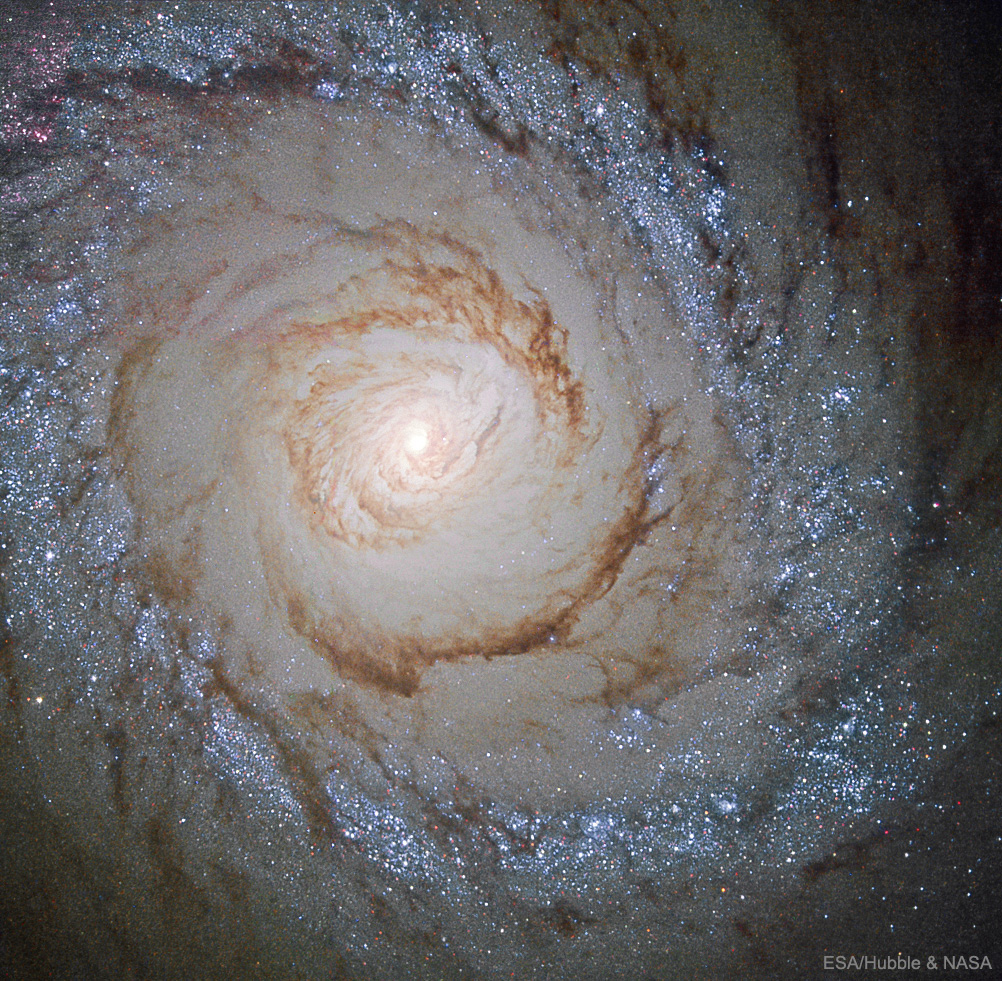
Another spectacular APOD (Astronomy Picture Of the Day) from NASA and the Hubble telescope: the Starburst Galaxy (M94)!  “A mere 15 million light years distant,” NASA tells us; that means that a beam of its light takes 15 million years to reach us.  Containing billions of stars, to us it is a tiny, faint point of light in the night sky.

I know I seem to be obsessing on these NASA photos.  But every new image I see paints a wider, deeper, and more wonderful picture of the universe our Lord has created.  And the incomprehensible distance grows between this universe and its beginning in an infinitesimally small seed in the palm of God’s hand barely 14 billion years ago.

Every APOD is a proclamation of the greater glory of God.

AFTERTHOUGHT:  I remember when NASA first launched the Hubble Telescope into space, back in 1990.  Shortly after launch, they discovered its main mirror was warped.  The TV comedians had a field day, mocking the scientists for their incompetence and calling it a boondoggle.  But NASA’s Space Shuttle astronauts fixed it in 1993, and it has been exploring the universe (and sending us these dazzling images) ever since. It is projected to continue working until 2030 or even 2040.

Thanks, NASA!  If only every government program worked this well.

More on Truman and Msgr. Swetland

[A while back, I wrote a post about President Truman’s decision to use atomic weapons to end the war with Japan. I specifically objected to remarks by Msgr. Stuart Swetland on Relevant Radio.  He has since responded, and I re-responded.  The full original post is here.

And, as I noted then, my dissent indicates no disrespect for the excellent work done every day by Msgr. Swetland and Relevant Radio, which I love.]

My original post began…

On August 6, the terrible anniversary of the bombing of Hiroshima, I was listening to the indispensable Catholic media outlet Relevant Radio, and I heard a curious interview with Msgr. Stuart Swetland on the subject of the day.

It made me think of Calvin Coolidge who is credited with many laconic (and probably apocryphal) anecdotes; my favorite is his supposed comment on returning from church one Sunday. Asked what the preacher spoke on, he answered: “Sin.” Further asked: “What did he say about it?”, Cal responded: “He was against it.”

Continue reading

Are We Being Watched?

Well of course we are.  Cornea, iris, pupil…

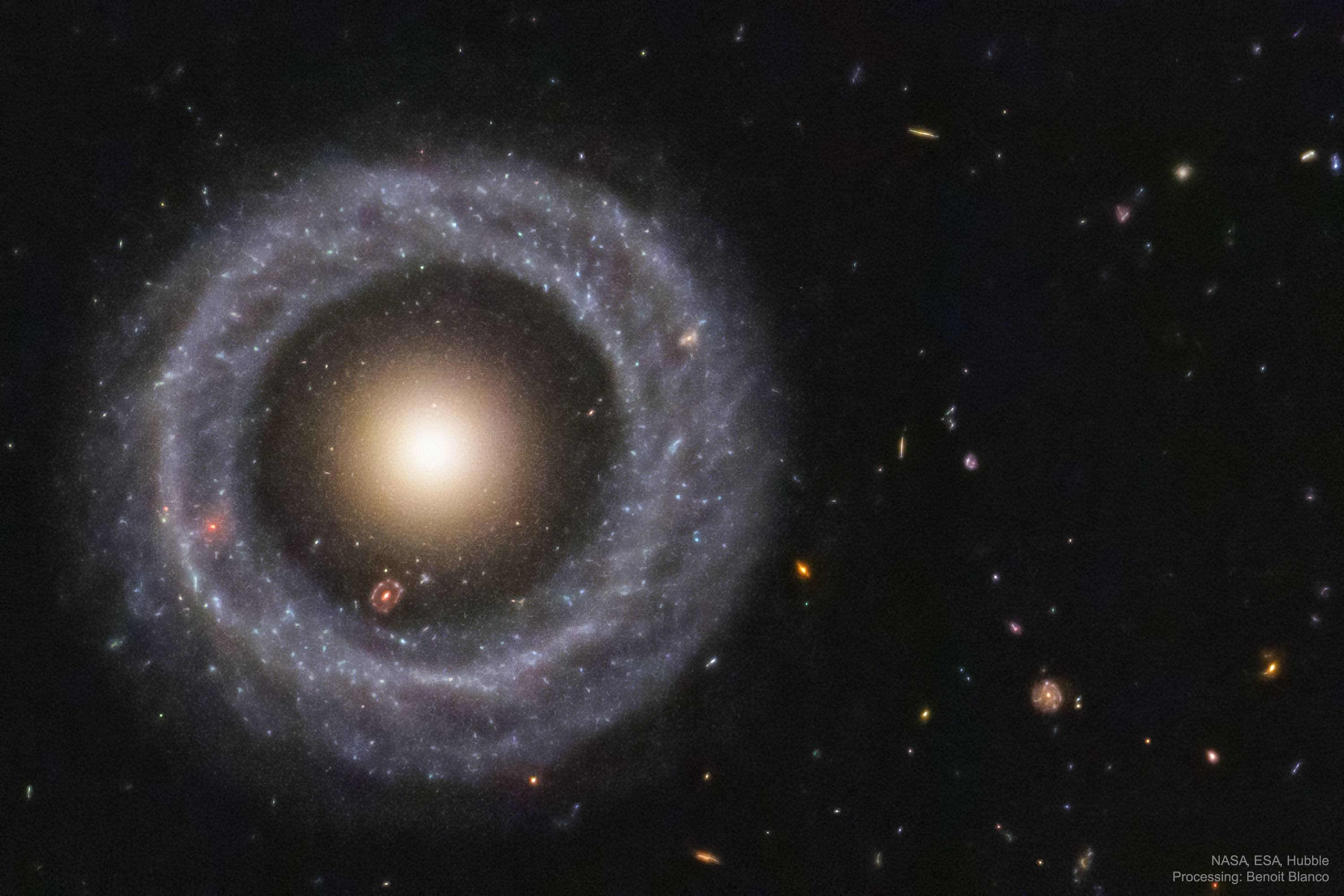
This amazing galaxy appears to be watching us.  Courtesy of NASA, this view of “Hoag’s Object” raises more questions than it answers.  The main star cluster in the center is surrounded by a doughnut-shaped ring of stars, with empty space in between!  You can actually see more distant stars and another ring-shaped galaxy through the doughnut hole. Also lots of other, farther-away galaxies are scattered around the picture.

And yet…  All this was once so compact and tiny that it would fit in YOUR hand.

See NASA and Psalm 19 for more information.


See Explanation.  Clicking on the picture will download the highest resolution version available.

Grow Up, Francis!

A good friend, an Irish-Notre-Dame-cradle catholic, says “I still like this pope”. Despite the clue contained in that “still”, he seems mystified why anyone (like me) thinks the papacy (and the Church) took a nosedive when Benedict retired.

My own spiritual journey, leading to my now-two-year-old conversion, owed a great deal to Benedict XVI, and found me towards the end hung up on the problems of joining his successor’s church. I finally made it over that obstacle, but I came into the Church as a worried layman wondering why the current management seems so unworthy and unlike its predecessors.

My PF concerns do not entirely overlap with those of some of his conservative critics. The divorced/remarried communion issue is not mine. I am not divorced, and I certainly can understand why pastors do not want to confront their divorced/remarried parishioners with such a tough choice as no sex or no Eucharist. [I do think the church’s teaching errs by considering divorce as a matter between two adults (and God, of course), thereby making the same mistake as our courts do: treating the children as a collateral issue. In my view, divorce between childless adults is one thing, while divorce with children is wanton, cruel family destruction, a particularly hypocritical form of child abuse. But that does not make “Amoris Laetitia” a problem for me. I wrote about this in “Suffer the Little Children: Aquinas on Divorce“, below.]

His non-response to the sexual abuse crisis is another matter. Continue reading