Category Archives: Church

THE PROPHETS GIVE VOICE TO GOD’S SUFFERING

In the weekly meetings of our Cornerstone Catholic Scripture Study group in Florida, we have spent the past 20 weeks reading the Prophets. We have studied the recurring cycle in Israel’s life with God: God makes a Covenant with Israel, Israel rebels, the prophets indict and warn, Israel continues to rebel, God reluctantly punishes, Israel repents, God forgives and renews the covenant.

The first Isaiah (ch 1-39) repeats the indictment and warning of punishment, and the hope of forgiveness, in terms consistent with the Prophets before and after him.

A century or more later, the second Isaiah adds a new element: the Suffering Servant, the anointed one (Messiah) that the Lord will send to reform and save Israel.  Earlier anointed ones were kings (David and Solomon).  But Isaiah’s Messiah is not a king but a servant, not conquering but suffering.

52:3 He was despised and rejected by others;
    a man of suffering[a] and acquainted with grief;

    he was despised, and we did not esteem him.

Surely he has borne our griefs
    and carried our sorrows;
  But he was wounded for our transgressions,
    crushed for our iniquities;
  upon him was the punishment that made us whole,
    and by his bruises we are healed.
All we like sheep have gone astray;
    we have all turned to our own way,
  and the Lord has laid on him
    the iniquity of us all.

He was oppressed, and he was afflicted,
    yet he did not open his mouth;
like a lamb that is led to the slaughter

This new element, the Suffering Servant, was so radical, so revolutionary, that other later prophets do not pick up on this element in Isaiah.  Not one of the prophets who wrote in the century and a half after Isaiah speaks of it. God apparently chose not to repeat it.

And then the line of Prophets ends abruptly after Malachi.  Why?  Four centuries of silence follow, until John the Baptist announces and Jesus fulfills the prophecies.

What happens during this four-century silence, this gap, this hiatus? Does the Cycle continue?  Sin and rebellion certainly do, but prophetic warning does not.  Why not?

Perhaps it is because the prophecies had become written scripture, incorporated into their liturgy, regularly taught to every Jewish generation. Sending another Prophet to repeat the message yet again might seem redundant. 

Or maybe it was simply too radical a message for Israel to understand at the time.  God knew they were not ready to give up their hope of an earthly, political rebirth of Israel as an earthly political kingdom under another David. 

But the Jews were even then being taught the one painful lesson that goes with Hope: Patience.  They were learning to wait patiently for a deliverer, a King-Messiah, no matter how long it took.

On a personal note, I had many hurdles to surmount before I could join the Church.  Mainly, of course, there was my sinful nature, especially pride.  But there was also what can be called the Jewish Problem.  My mother’s family were Jews (non-observant).  And they and I felt very strongly the thread of anti-Semitism that had run through Church history.  From early times, many in the Church had blamed the Jews as a people for having condemned Jesus, and that had been the major factor in creating the racist scourge that is anti-Semitism.  The term “Christ-killer” came from the earliest days of the Church. Of course, some of the Temple leaders and their followers were indeed guilty of Jesus’ death.  But not all Jews in Jerusalem that day were involved, and certainly none of the ones born later.  Yet all Jews throughout the ages since have felt the sting of Jew-hatred on the part of Christians (and the non-Christians to whom it quickly spread). 

It is true that many or most Jews did not accept Jesus as Messiah or convert to Christianity, in the Apostle’s time or since.  But it must be recognized that there was a stumbling block in the road for them (as St. Paul put it): they were expecting a King-Messiah, not a humble village preacher-healer.  They had so learned the lesson of patience that they would not (or could not) give it up. Many are still waiting for the Messiah today.  And an added stumbling block was set in their road by misguided voices in the Church: anti-Semitism.

I was led past this stumbling block by wise Catholics who showed me how various saints, and especially St. John Paul II, had reached out across this divide, embracing our “Elder Brothers in the Faith”. That did it for me.   I could join a Church that could still move forward to correct past mistakes.  (I am often reminded of the clever convert’s answer to the question “But why the Catholics?” He answered that “the Catholic Church is for saints and sinners only; righteous folks are welcome at any of the Protestant chapels down the street”.)

And I marveled at the unlimited patience of the priests (as well as a Jewish deacon) who brought me along the path I walked, patience that was undoubtedly tested but undiminished in the several-year course of my questions, doubts, objections and hesitations.  As I’m often forced to admit, I am a very slow learner. In the words of the Cornerstone prayer, “Thank you, Lord, for the grace that has led me to this moment.”     

But, back to the post-prophetic gap after Malachi:  What we know of Israel’s history during this period is largely political. The Assyrian-Babylonian-Persian imperial rule is succeeded by Greek rule, under Alexander the Great and his successor regime, the Seleucids. These Greeks introduce much of their culture, but it is not until the second-century, when a Seleucid king tries to invade the Temple, that Israel revolts; the Maccabees rule a semi-independent kingdom until the Romans arrive, 63 years BC-“Before Christ”. Which brings us to a stable in Bethlehem.)   And this brings us to the greatest of all revolutions: the Jesus Revolution. The one that began with Jesus and the Apostles and disciples and is still going on today.

The Gospel writers had little difficulty seeing that Jesus was the Suffering Servant, since Jesus himself made it clear.  In Luke 22:37, at the end of the Last Supper he says:

“For I tell you, this scripture must be fulfilled in me, ‘And he was counted among the lawless’; and indeed, what is written about me is being fulfilled.” 

In the next verses he is arrested.

Isaiah shows up more often in our Catholic liturgy than any other Prophet, and it’s easy to see why.  Here is the clearest prediction and promise of the Messiah, the Christ; foretold by Prophets living centuries before he was even born!

What happens after the resurrection of the Messiah?  The Cycle continues, but now the new Covenant is not with a chosen people, but with all humanity.  Jesus becomes the new and eternal covenant and it is sealed through his suffering, blood, death, and Resurrection….and then sin and rebellion continue.  But something else happens. 

As I said, the Romans arrived in Judea 63 years before the birth of Jesus, the Suffering Servant.  And the Roman Empire was fertile ground for the spread of the Gospel.  The previous empires were not. We hear very little about Assyrians or Babylonians or Persians converting to the worship of the True God.  (Even after Daniel’s miracles repeatedly appeared to convert their kings, it never seemed to last.) But Rome was different: it was ripe.  For several reasons: it was relatively tolerant of religions that did not upset things too much. (Given the coming persecutions, it seems odd to think of Rome as tolerant of non-Roman religions. But it was relatively so.) That is why there were so many Jews living in Roman colonies, especially Egypt (the Diaspora caused by the earlier conquests of Israel).  And in Rome, many pagans had chosen to convert to Judaism, because they were impressed by the moral behavior of the Jews (in stark contrast to general Roman immorality, which often approached Sodom and Gomorrah levels).  These converts were called “God Fearers”, and they were common in Roman synagogues, and they were frequently the early converts to the new Jewish sect called Christianity. 

Of course, the Roman emperors quickly realized how disruptive Christianity could be, and decided to persecute Christians as brutally as possible.  But it was too late.  The cat was out of the box, and no numbers of martyrdoms would put it back. 

The Roman Empire becomes the incubator of the faith that would spread throughout the world! 

The entire Bible story foreshadows this expansion.  Starting with one faithful man (Abraham), it grows into a family and a tribe, becomes a nation, and from that nation in the fulness of time it expands to the whole world.  After some false starts and setbacks and failed covenants (Adam, Noah…), humanity has been taught how to live with God and under God. We still sin, but not out of ignorance.

The Prophets have given a voice to God’s Love, Mercy and Suffering in very human terms.  Our sins and rebellions cause God grief, pain, and anger: very human responses.  Isaiah’s God, our God, is quite different from the Philosopher’s God of Plato and Aristotle, so far above and beyond us.  Our God is human as well as divine, as we learn when he sends his son to us.  We cannot comprehend God without a human face and voice. And God suffers when we sin.  That is what Love requires.  Who of us have not felt the pain of a loved one’s sin?  That is the message that the Prophets and Jesus bring to us.  And that, I believe, is why we have a crucifix hanging before us in every Catholic Church.  Not just an empty cross, but a more-or-less realistic image of Jesus suffering and dying for our sins.

Let us pray:

Thank you, Lord, for our many blessings, those we recognize and those we do not.  Forgive us for our sins that have caused you suffering.  May your loving kindness reach out to those others who have suffered at our hands.

AMEN
My Favorite Lines from the Liturgy

I see my friend Mister Hans Moleman has posted some of his favorite lines from the canon of Marxism. OK, Groucho Marx-ism.  Along with a favorite bit of Monty Python-ism, from a movie that even he describes as “arguably pretty sacrilegious, anti-Christian, and anti-Semitic, but inarguably funny.” Hmm.

Anyway, it reminded me to write my own list of favorites…from the Catholic Liturgy of the Mass. I have been thinking of calling this “Hidden Gems from the Liturgy. But that sounded like I was a treasure hunter finding unrecognized beauties where no one else thought to look. So I simply acknowledge these as my favorites, as words that never fail to ring a bell in my mind when I hear the priest pronounce them.

“…Fruit of the earth and work of human hands…”

At the beginning of the Liturgy of the Eucharist, the priest blesses the Lord for the offering:

…Fruit of the earth and work of human hands…

What a beautiful, poetic description of the bread we offer, as well as any other vegetable, food, wood, or even ornamental landscape. How simply these words describe the relationship of the farmer (or landscaper or backyard gardener) with the processes and products of agriculture (or silviculture or …).    (And, of course, the wine we offer God: “fruit of the vine and work of human hands…”  When I work in my own garden, these words come to me often.

In the Preface dialogue, the priest asks us to “Lift up your hearts.” We reply: “We lift them up to the Lord.”

This is just beautiful, in English or in the Latin “Sursum corda. (see below)

But for me the highlight comes next. “Let us give thanks to the Lord our God.”  We reply that “It is truly right and just.”

The priest continues: “It is truly right and just, our duty and our salvation, always and everywhere to give you thanks, Lord…”  Can you spot the hidden gem?  This one is not only a gem but also kind of hidden.

ALWAYS AND EVERYWHERE!”    

Continue reading

THE CONTINUING CRUCIFIXION

AN EASTER THOUGHT

[I wrote this in 2018, on my first Easter as a Catholic Christian, shortly after the service at St. Raphael’s in Englewood Florida. I think the same thoughts every Easter.]

In church today for the Easter service, I found myself swept up in the joyous spirit.  The music, the liturgy, the homily, all so spirit-lifting! But I had one disturbing thought as I looked at the crucifix: it seemed out of place, jarring and untimely.  We were celebrating the risen Lord, but the unavoidable centerpiece of the church was the crucifix, graphically displaying the dying Lord.  Didn’t the crucifixion end? Hasn’t Christ risen?  Then why, on this most joyous day, are we faced with death – His death? His gruesome, grisly, tortured, pathetic, painful death?

On Good Friday and Holy Saturday, commemorating the time when Jesus was in the tomb, the crucifix was covered, removed from sight, signifying His terrible absence from us.  But on Easter Sunday morning, He is back. We welcome Him home…but as I look behind the altar I see that He is still suffering, even dying!

As a very recent convert (and long-lapsed Protestant), I have been thinking much about crucifixes. These depictions of our Savior dying on the cross adorn most (sadly not all) Catholic churches.  In this, we are (as far as I know) unique. Protestant churches usually have crosses behind the altar, but rarely are the crosses occupied.  I suspect Protestants see the crucifix as needlessly maudlin. (Perhaps an appropriate word, if we remember its origin in the person of Mary Magdalene.)

The empty Protestant crosses seem analogous to the empty tomb. The crucifixion, the death, the burial, all are in the past.  We move on.

But Catholics present the cross complete with the body of Jesus. The “corpus” may be symbolical or impressionistic, often bloodless, all in consideration of modern sensibilities about bloody, tortured bodies. But they are still painful to see.

I have not read an explanation of why Catholics embrace the crucifix where Protestant do not. But I am finding the crucifix a useful reminder that now, as in the past, every sin hurts God. Every sin requires an atonement.  Sin is not just an internal, private or inter-personal matter between me and anyone I injured with my sin. Every sin hurts God. It has to hurt Him if He truly loves us, as I now believe He does.

And so, for me, the crucifixion never ends. It continues as long as sin does – that is, as long as I sin. And it is a great blessing to be reminded of that fact every time I step into a church.  Even on joyous Easter.

Parish Priests, the Saints Among Us

St. John Vianney, the Cure d’Ars, the patron saint of parish priests, apparently believed that no parish priests ever became saints.   Fr. Walter Gumbley, O.P. wrote a little book, Parish Priests Among the Saints, (1947) in correction.

From Gumbley’s introduction, “It has sometimes been stated that, with the single exception of St. John Vianney, no parish priest has become a saint.  Henri Gheon, in his The Secret of the Cure d’Ars, relates that the holy man was ‘terrified to learn that in the long roll of the ages not a single parish priest had been raised to the Church’s altars as a saint.  Popes had been canonized, cardinals, bishops, religious and laymen; but of parish priests not one; not the shadow of one.’”

Gumbley goes on to demonstrate that this is erroneous, listing 31 cases (pre-Vianney) in refutation.  (There are probably additional relevant canonizations since 1947.) But none of his cases are particularly well known, and only a few were canonized for their display of holiness explicitly in the exercise of their regular parish duties. (Most clearly on point was St. Peter Fourier, who died in 1644, and was canonized by Leo XIII in 1897.  But since Vianney died in 1859, he would not have known of his distinguished predecessor.)  Gumbley also points to St. Ivo Hellory, who died in1303 and was canonized in 1347. Ivo was a canon lawyer and ecclesiastical judge, but gave up his law practice to serve as a parish priest (which by itself seems sufficient ground for canonization.)

So the Cure d’Ars was wrong, but not by much.   Parish priests are, to say the least, underrepresented in the lists of saints.  One might wonder why.

In the middle ages, parish priests were the proletarians of the clergy: lowly regarded, criticized as ill trained, lax, or corrupt.  Reform movements usually arose from monastic orders.

But with the rise of structured seminary education, parish priests are now well trained and dedicated, and work longer hours than any labor law would permit.   The expectations of today’s catholic parish priests are far higher than any other church’s pastoral duties.

So, maybe the shortage of saints among parish priests is simply because the basic job expectations are so high.  Exceeding those expectations really takes some doing.  (Underachieving, however, appears to be all too easy.)

There probably ought to be a lot more recognized parish priest saints.  There probably ARE a lot more than we will ever recognize, until we meet them in heaven. 

Until then, consider your parish priest.  If he seems to be genuinely Catholic (not a “progressive” modernizer), and he is as hard working as mine, he is probably a saint-in-the-making.  Remember to give thanks to God for him in your daily prayers.  And thank your parish priest, too. Do it often.

ADDENDUM

In the above post, I relied on Fr. Walter Gumbley’s 1947 book (Parish Priests Among the Saints) listing 31 parish-priest-saints.  I also noted in passing that “There are probably additional relevant canonizations since 1947.”  Unfortunately, I have been unable to find such an update.

But I have noted a relevant source on this matter.  Robert Royal’s 2000 book The Catholic Martyrs of the Twentieth Century is a remarkable collection of data and stories detailing a grim reality: the 20th century saw a worse slaughter of believing Christians, especially Catholics, than any comparable era in history.

He analyzes these mass martyrdoms in country after country.  Some are not unexpected: Communist China, Nazi Germany, Soviet Russia, Turkish Armenia.  But the most striking are the Catholic countries in which “the appearance of virulent anti-Christian ideologies and brutally repressive regimes seeking to impose them…led directly to the widespread suffering and slaughter of religious believers,” including parish priests. 

The Spanish Civil War of the 1930’s is widely remembered as a heroic struggle against fascism.  In fact, it began with brutal attacks by communists, socialists, and anarchists against the Catholic Church.  In the first six months of the war (1936), 6,382 priests, monks, and nuns were massacred by the “Loyalist” forces.  Royal says “perhaps the greatest fury fell upon diocesan clergy” (parish priests). In cities controlled by the left, hundreds of priests were murdered: in Madrid alone, 1118.  Unarmed, unresisting priests murdered for doing their duty to their parishioners, their Church, and God.  Martyrs.

The Church has since recognized many new martyrs and saints from these cruel persecutions.  I do not know how many were parish priests.  But I suspect that they were all too well represented in the ranks of the sainted martyrs.

As I said before, “there probably ought to be a lot more recognized parish priest saints.  There probably ARE a lot more than we will ever recognize, until we meet them in heaven.

I Was Glad When They Said Unto Me…

[My friend Dan Wing has asked my thoughts on this strange Easter. Here they are.]

Dan, I have often shared with you my love for our Cathedral and how I miss it during the long winter months I spend in Florida. The parish I attend there is a sad affair, a church that feels old and tired. Literally old, as the congregation is almost 100% retired and 65+. And figuratively tired, as there seems to be no awareness of any of the challenges the church is now facing.

In Montana, I feel old; but in Florida, the world feels old. I prefer the Montana feeling. And throughout the Florida winter, I dream of attending mass in the magnificent Cathedral of St. Helena when spring arrives.

At my conversion, you helped me find my place in God’s world.  At the time I especially felt the truth in Psalm 122: “I was glad when they said unto me, let us go into the house of the Lord.” You and Cherie were two of the ones who most persistently said it unto me.

And I remember that joy I felt, and still feel, whenever I have the chance to enter our Cathedral.

Yet now I have been back in Montana for a month, and still have not been to a single mass here. I am of course grateful for the opportunity to be of help to my family in this time of crisis. And my heart leaps with joy whenever I see our beautiful Cathedral on the hill as I drive through town. But still…

I know you and so many others feel the same sense of loss that I do.   In my case I wonder if this sense of loss could be a part of the purgatory my sinful heart needs.

The emptiness that has often hit me this month has sometimes seemed like an extended Holy Saturday, a day with a conspicuous absence in its heart. Now, He is Risen!

But the challenge continues. How to keep the holiness of God in my heart without the help of the sacraments and our priests?  Very hard, indeed. The Magnificat helps with regular devotions. And my daily diet of “Thank You, Lord” prayers find no shortage of occasions.

But still I long for the day when I again hear “Let us come into the house of the Lord” for mass. And I think it may be a foretaste of the day I can walk joyfully into God’s full and complete presence. God willing.

Yours in Christ

Happy Re-birthday to Me!

Last week I celebrated an anniversary of some significance, at least to me.

Not my birthday. Not my wedding anniversary, which my wonderful wife of over 47 years (wow!) and I celebrate in November.

Here’s a hint: In Gilbert and Sullivan’s Pirates of Penzance, the plot turns on a paradox. The hero, Frederick, was in his youth apprenticed to a pirate. (Which was an error, of course, the result of a failure to communicate; he was supposed to be apprenticed to a pilot.) He detests piracy, but his sense of duty compels him to complete his apprenticeship term at age 21. Unfortunately (SPOILER ALERT) his apprentice contract was poorly written, to end on his 21st birthday. But (SPOILER ALERT) he was born on Leap Year Day, Feb. 29, and only has a birthday every four years. So, he still has sixty-plus years to go. (If you haven’t seen or read the play, you really ought to.)

Anyway, last Saturday, the Feast of Saint Matthew, was the anniversary of my baptism and confirmation into the Catholic Church; my Second Anniversary. (That’s right. It took me almost seven decades to figure out where I belonged. I’ll bet it didn’t take YOU that long, dear reader.)  My re-birthday, if you will.

I can therefore paraphrase Frederick, singing:

“Though counting in the usual way,

Years seventy-one I’ve rocked and rolled.

Yet counting from my re-birth day,

I am a little two-year old.”

[Sorry about the “rocked and rolled”; I am not a very good poet.]

It is a strange and wonderful thing to be both an old man and a young Christian; aged in years but youthful (even childish) in the faith.

So if you see me around town, feel free to wish me a Happy Re-birthday. (A friend in college once received a birthday card stating “It’s my birthday! Buy me a beer!” He wore it pinned to his shirt for weeks, gradually hitting every bar in town.)


Note: Saint Matthew is not only my patron saint, but also that of (among others) tax collectors. This is based on the tradition that he was one himself.  That may be why I Continue reading

O Beauty


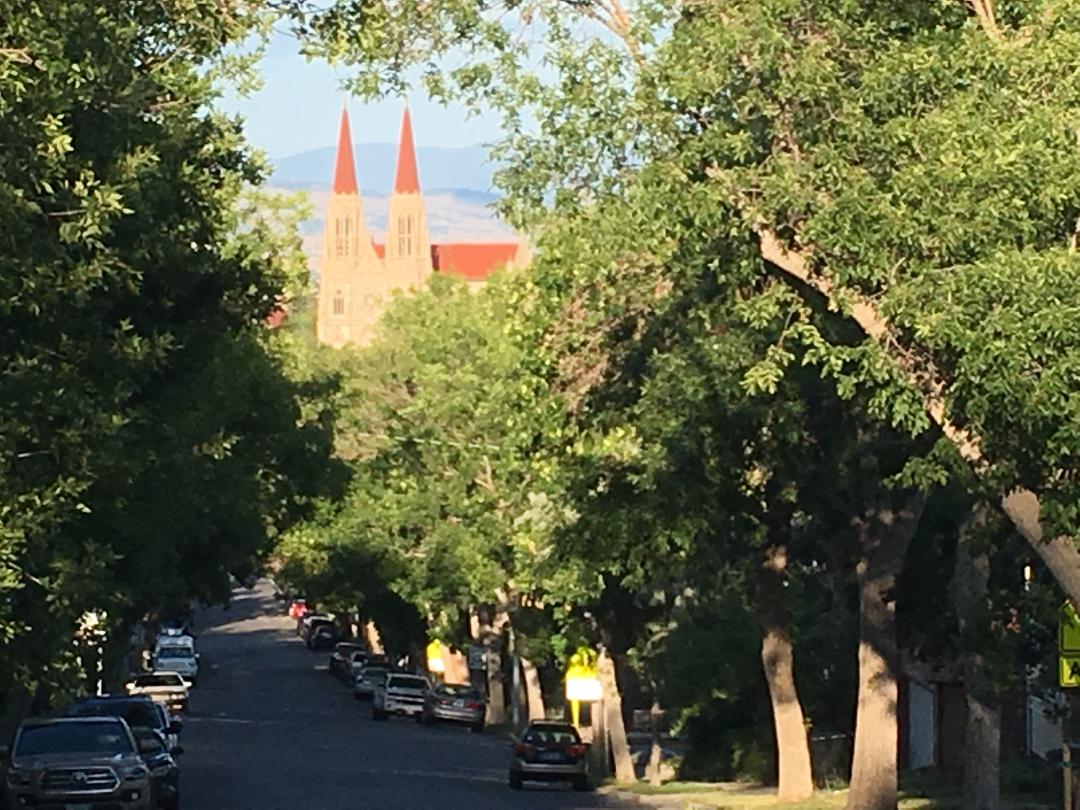
Cathedral on Lawrence 1 IMG_3850

“Late have I loved thee, O beauty, so ancient and so new.”

(“Sero te amavi, pulchritudo, tam antiqua et tam nova.” St. Augustine, Confessions)

My parish church in Helena, Montana: St. Helena Cathedral.

I-phone  photo taken today, a block from my Helena home.

The Church Stands Alone

In the Pedophile Priest Crisis, the Church (specifically its internal corrupters, the pedophile priests and their superiors in the hierarchy who refused to take responsibility) was in the wrong.  The world helped correct it.  That is, the news media, law enforcement, and especially the lawyers of the plaintiff’s bar.  They publicized and sued and brought the scandal to public attention, forcing the Church to deal with it.

In the present Homosexual Crisis, the world stands enthusiastically on the side of the Church’s internal corrupters.  The media love the current pope and his “See No Evil” approach (along with his breezy off-the-cuff airborne theology).  The media and other elites all shared in the near-universal horror at pedophile child abuse; but they all equally support the Homosexual Agenda, from normalization to gay marriage to transgenderism.

The only voices being raised against this grooming-and-groping-and-worse behavior of some bishops come from the much-despised “Traditional Catholics”, smeared by their own pope as “Pharisees”.

G.K. Chesterton wrote somewhere (I think in Orthodoxy, but I don’t have a copy handy so I am quoting from memory) that when the world becomes too worldly, it is the church’s role to turn it around. But when the church becomes too worldly, the world cannot save it.  Only the church (through the Holy Spirit) can save itself.

There will be no outside help, no cheering from the sidelines.  The press coverage will be terrible.  We already see the calumny against the traditional church as a homophobic institution, a bunch of haters in Knights of Columbus uniforms.

It will be a lonely battle.  There will be no one on our side…except the Holy Spirit.

Reprise: “I Am That Man”

[By request, a rerun of a previous post. Plus a few Digressions.]

A few years ago, in RCIA at the age of 69 after a spiritually wasted life, I was finally getting serious about many things, including the Bible readings.

 But I was taken aback by one of the vineyard parables (Mat 20):  the one where the owner pays the same daily wage to late-arriving workers who only put in an hour’s work as he pays to the laborers who worked the full day.

As a former union representative, I rose to point out the unfairness of this.  It would violate wage and hour laws, not to mention any union contract.  The result would be a grievance, a federal charge, or a walkout.  The late worker would be singled out for derision (or worse) as the owner’s stooge.  My objections cut no ice. Salvation economics, I was told, were different from labor economics.  I dropped the subject, filing it under “Catholic Stuff I Don’t Get…Yet” Note: (There are still a lot of these. See the Digressions below.)

But later, at my first communion, the daily reading was that very same parable.  And after re-hashing the same issues in my mind, it suddenly dawned on me – I was that man! I was that laborer who showed up near the end of the day and happily, if a little guiltily, collected my full wages.  And, most amazingly, the other workers seemed happy about it. No grievances were filed.  No cradle catholic shunned me as an upstart.   They actually welcomed me!

Now whenever I see someone full of self-esteem and entitlement, the kind of guy who is convinced that he deserves all the good things life has given him, I have to remind myself that “I am that man.”  And when I am with one of the many good people who have been working in the Christian vineyards their entire lives, I feel my own unworthiness all the more.  But I know that this is the way God’s grace works.  My job is to accept the grace, and to pass it on.  And to keep at it until my workdays come to an end.

_______________________________

 DIGRESSION #1: One of the things I don’t get, or at least don’t like, is the New Testament’s low opinion of tax collectors.  I understand the history of the inherent corruption in that ancient imperial system, but surely there must be a better word for those corrupt officials. The Greek “telones” and the Latin “publicani” described contemptibly corrupt characters.  The modern-day American tax collectors I have known (and represented as union members) are upright, honest public servants. I don’t recall ever having to represent one accused of theft or embezzlement.  How must they feel when they read the gospel references to “tax collectors and other sinners”?  So Bible translators, get creative and come up with a better term.  “Corrupt officials”? “Crooked bureaucrats”? 

DIGRESSION #2: Speaking of Bible translators, why does the Catholic Church use such lame ones?  Consider Matthew 16:18. KJV: “The gates of hell shall not prevail against it” [the Church]. New American Bible: “The gates of the netherworld…” Netherworld? The image conjured up suggests Holland, not Hell.

Or consider Psalm 23:6. KJV: “I shall dwell in the house of the Lord forever.”  NAB: “I will dwell in the house of the Lord for years to come.”  How many years? Two? Three? How long have I got until my lease expires and God throws me out?

DIGRESSION #3: Speaking of crooked public officials, one of my favorite lines from Casablanca is spoken by the dastardly police captain Renault, played by Claude Raines. Rick (Humphrey Bogart) proposes a twenty-thousand-franc bet that Victor Laszlo will escape to America. Renault responds “Make it ten thousand. I’m only a poor corrupt official.”


PF and the Mirage of Fraternity

The most insightful thing I have read online lately comes from the always-insightful Maureen Mullarkey at studiomatters.com. Entitled “Francis and Mirages of Fraternity Part I”, it is an analysis of this pope’s Christmas message, filled as it is with the French Revoliution’s favorite cliche.

MM shares the trenchant analysis of Daniel J. Mahoney’s The Idol of Our Age, subtitled How the Religion of Humanity Subverts Christianity.

You don’t need to be as brilliant as MM to notice that PF generally sounds like an episcopalian, modernizing, progressivist, liberation-theologist cum-feel-good political therapist.  Even while  abandoning the legacy of his predecessors’ rich theology, he exceeds their worst failings in the oversight of his clergy’s sins.  Where John Paul and Benedict too often failed to drive the worst abusers from the temple, PF welcomes them back.  Where they were too ready to forgive, he seems too eager to seat them at his right hand.

Anyway, I strongly recommend that you take a look here.